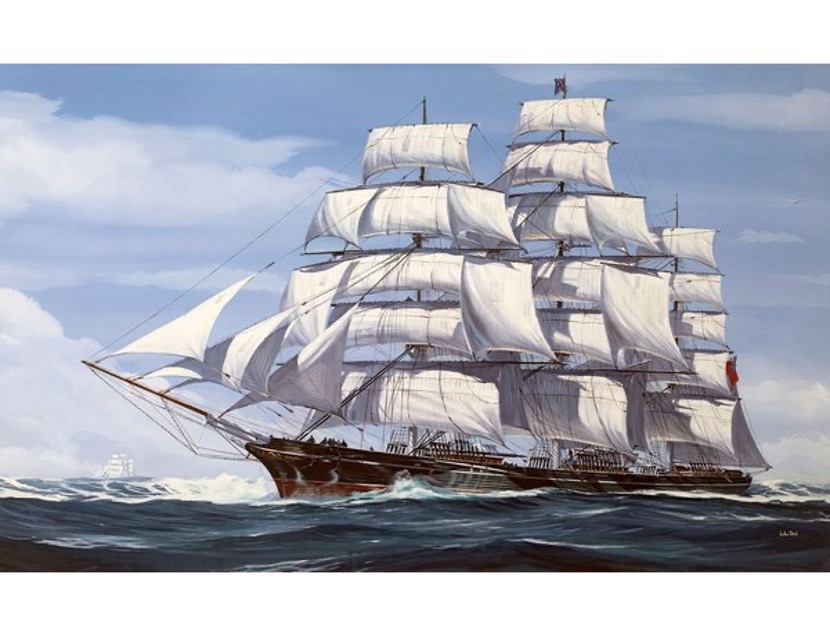
She will sit for a century, beside the River Thames at Greenwich, glorious testimony to an ended era of sailing grace. Only a captain with a lifetime of sailing experience could master her.
Conceived to contest the Tea Clipper Race, of 1870, she was launched in Scotland in 1869. The Cutty Sark – named after the comely warlock in Burns’ famous poem Tam ‘o Shanter by her Scottish owner, (White Hat Willis) – nosed into the current on the River Clyde and began a career where she would become famous circling the world continuously until 1923.
Most of the great sailing clippers, wrecked within twenty years of their launch; disappearing with all hands, without trace in the Great Southern Ocean or for the more fortunate crews, ending their days as beached bones rotting on a sand bank somewhere across the world between Japan and the Falkland Islands.
The Cutty Sark, almost alone amongst these ‘greyhounds of the sea,’ led a charmed existence, she survived. By the time she retired to her present berth in 1954, she had endured typhoons and hurricanes, capsize; she de-masted, (several times), and groundings. She suffered poor maintenance by mean owners and in the early 1880s, survived several voyages in the hands of a drunken skipper. She rests today in a dry dock beside the Thames at Greenwich; curiously, somewhere she would so often have sailed past, an hour from the end of so many of her epic voyages.
Built for speed and to an exceptionally demanding standard, one that bankrupted her builder, the Cutty Sark’s maiden voyage was to Taiping in China where she picked up a cargo of Lapsang Souchong – the original tea first brought to the UK. London tea auctions each season, attached prestige to the first cargo of tea to reach our shores; a bonus to the crew and a 50% uplift in the price of the cargo. Willis, a lifelong Ship owner and ex-clipper captain, was determined that Cutty Sark would win this honour.
The Cutty Sark and another supremely fast clipper, the Thermopylae, weighed anchor in the river Estuary at Taiping within four hours of each other in July 1870 and so began the last great sailing tea race across the World before steam ships would capture the market, taking a shortcut via the Suez Canal; a route that head winds in the Red Sea denied the clipper ships.
Down the coast of China and through the treacherous Straits of Malacca and into the Indian Ocean, the two clipper ships pressed for advantage, squeezing every knot from the wind, taxing the expertise of their vastly experienced captains and the muscle and courage of their crews prepared to go aloft in hammering seas,
A day’s sail from the Cape of Good Hope, when the Cutty Sark – shredding all previous records – was over 500 miles ahead, a huge sea tore away the Cutty Sark’s rudder. Her race was over. The Ship’s carpenter scavenged sufficient materials and on the open deck manufactured a makeshift rudder. In mid ocean, drawing extraordinary courage from this man who – like most crewmen of the day -could not swim, as he was lowered repeatedly over the stern and submerged twenty feet to the plunging keel where he guided into place and secured the replacement rudder as it was lowered into the water. This allowed the captain to sail to Cape town where a replacement rudder was fitted.
Repaired, the Cutty Sark continued her voyage, sustaining sufficient speed over the remaining 8000 miles of the Atlantic and the Channel to secure second place, reaching the Market in London, less than four days behind the Thermopylae.
Years later, when, by all standards middle aged for a sailing vessel, and under the command of Captain Woodget – who would for ten years – between 1885 and 1895 – become her most successful skipper, the Cutty Sark logged what is still today the World Record, fastest time for a sailing ship between London and Melbourne in Australia of 61 days.
On the 14th July 1889, Second Officer Olivey, watch keeper on the bridge of the Steam Ship Brittania, out of London, enroute to Perth Australia, recorded in his Ship’s Log that whilst maintaining best speed of 16 knots (as a crack P&O steamer) he observed, on the horizon astern, a sailing clipper. Over the period of the afternoon he watched as the Cutty Sark, in full sail, plunging through every wave with spray flying for over half her length, overhaul and pass them before she disappeared ahead.
This incident became a chapter in the folklore of mariners across the world, and the ship that performed this feat over 130 years ago, rests now in its dry dock at Greenwich, waiting for you to visit. It is the fastest Tall Ship and clipper the World has ever seen and now, the only one that survives. A ship with character that in its time was recognised and respected by all sailors and particularly by each of the extraordinary men who brought their expertise and courage to bear and risked their lives as they went with her to sea.
 Beaky's Blather
Leave a comment