Having surprisingly negotiated my way past the MoD policeman manning the gate at 3am in my unprepossessing vehicle and now parked on the Station’s only carpark, the engine silent, I sat behind the wheel in the dark and gazed across the carpark towards the gym where I had my office and reflected quietly. What now? In a few hours I must present my barely-thought-through idea – the bus project with my boss, and the station’s exec and somehow be sure that I did not seem… what? Well, odd frankly.
Aged 29, I had joined the RAF the previous year. A late starter, I had however orchestrated my career change well, successfully; it had already become clear to me that I was well-regarded by both my own staff and by the station’s senior officers. Was I about to make a miss step?
I had brought this old bus over three hundred miles south and onto my RAF base having scarcely considered the challenge that I would now face. I had not thought it through. I would now face some sceptical colleagues, hopefully the most senior to me who would be positive but inevitably there would be those who were not. Winning people over to embrace an unconventional solution and recognise the possibilities it offered was I feared, not going to be easy.
I was new to the RAF but I had recognised already that it was not an organisation given easily to innovation. Tolerance of the radical or unusual was not in its DNA. I suspected, it was in mine.
What could go wrong? – Oh dear. Quite a lot, I was beginning to recognise.
It was going to be essential, l concluded, that I by-pass the Unit’s middle ranking senior officers and aim higher. I was beginning to recognise that must persuade the Station Commander himself. I would remind him that I was presenting him with a potentially creative solution to a problem that he had invited me be creative and address. This was true, he had. If I could win him over and he embraced this bus project, the objections of those below him although above me, they would I hoped largely melt away. I decided that I would frame the bus project for him as a low-risk, creative outside the box solution to a very real problem. One we currently faced. I would offer it as primarily a solution for transport to the local playing fields…. or mountains and rivers etc, but the places anyway that we had routinely accessed before the imposition of the Moratorium.
It was the best I could think of. I was tired. I needed to get a couple of hours sleep and rise before six thirty in order to return to the unit, spruced up smartly in my uniform, and waiting outside his office, with a clear explanation for the ugly old bus that he may have just noticed as he passed the station carpark minutes earlier and I had to clearly explain the rationale … why I thought the bus project good idea. I checked my watch, it was 4am. ‘And so to bed’… briefly.
A former Navigator, our station commander, Jack Broughton was a wonderful senior officer and man – in my view. He seemed to me to be friendly, open minded and flexible. As I arrived he looked ot me paused and said …
‘Something on your mind Paul? Come on in. Once I had explained my proposal, explained my thinking – keeping it brief and clear – emphasising but not labouring the rationale. He thought for a moment, picked up his phone and asked OC Admin Wing, who was my boss to step into his office. He summarised my project quickly and accurately, much more clearly than a moment earlier had I. He immediately continued and asked my boss to oversee my project and monitor any fund’s and finances involved through the unit’s Non-Public Fund and with that, after no more than ten minutes from my arrival, he gave the bus project a green light. I breathed again. It felt as if for the first time since I had entered his office moments ago
It was, Jack Broughton who christened it – ‘Beakys’ Bus.’ It was when he arrived in the car park to wish us well for as we departed on the first expedition that I took the bus on – with around fifteen or so personnel to the Black Mountains in south Wales, The very hills that the SAS use for trading although I am certain they would have rushed past us had my little band encountered them as we walked the mountains.
Jack Broughton – as I’ve explained, our Station Commander – habitually and unpredictably at some point most weeks, woulf arrive unannounced in my in my office. He’d drop onto the seat opposite mine across my desk and say,
‘Tea Beaky, standard NATO – how are my guys?’ And I’d tell him what I knew. What I had picked up informally from the many people who used the gym or volunteered to take part in expeditions and all those in any of the thirty-two station clubs or facilities that I was responsible for helping. supervisise and hi auditing each month largely by advising the SNCOs who ran them. I was always surprised to discover that he seemed to know the names of even the wives and children of most of the people I mentioned on the unit. I really liked him, and it seemed that he liked me too. I loved my job. I thought it a wonderful first posting.
Beaky’s Bus proved itself a huge success in its role at West Drayton and in no small way helped re-ignite both the station’s sporting and expedition opportunities that it now made more available simply by providing a transport solution suitable for almost any activity. The funds that came into the bus’s non-public fund from the many journeys it undertook swelled quite quickly. The Bus Fund gradually increased – and the oversight of the fund and the operation of the bus that the CO had decreed was to be monitored identified no problems. So…I bought another bus.
I bought a recently retired, National Express coach from Maidstone and District, the main bus operator in Kent. The bus was, as you will see on all motorways still today, white with National Express emblazoned down its sides. Built in 1971 it was only nine years old and it had been retained for use exclusively on their Scottish Highland Tours. The Chief Engineer explained to me that the bus he could release to me had enjoyed an unusually gentle life travelling to Scotland infrequently and now, Maidstone and District had abandoned its Scottish Highland programme, so it had lain, largely unused in the corner of the depot for months. The vehicle was redundant and cluttering up precious garage space. He wanted rid of it. He was pleased to find somewhere to sell it where it would not find its way subsequently to a competitor coach company and return back on the roads of Kent, stealing passengers he would rather travelled on one of his vehicles.
Selling a vehicle to the RAF, he told me, avoided such a problem. He doubted the RAF would go into business against him. He almost begged me to buy his redundant bus and hinted quite clearly that I need just name my price. If I recall correctly, I bought the new vehicle tor almost the same price as I received when I sold original one. That vehicle interestingly was snapped up by a bus preservation society. It transpired that it was the only remaining example in the world of a particularly rare, first generation, lightweight monocoque construction bus. The cost of changing the buses was under a thousand pounds.
Beaky’s Bus was now a serious, go-anywhere vehicle. Capable of cruising at 70 MPH, the replacement bus was easily suited to the long distances that I anticipated I would progress to. It was, as I was soon to discover utterly reliable; I seldom encountered any mechanical troubles and only infrequently had call to drag out the large toolbox that it always carried.
The first more challenging expedition that I organised was a 2-week, ski trip to southern Germany on the Swiss Border at Garmisch Partengarten, Oberammergau and the Zuckspitz. 37 members of the Unit piled onto the bus with all their equipment. This was my first expedition into Europe and it was a great success. Emboldened, I expanded the range of activities we offered as our station’s outdoor programme. Initially, the programme within the UK, where the bus soon regularly took people on expeditions – mountaineering, canoeing, climbing and even – when conditions were ripe – winter ice climbing. There were many expeditions to Wales and then to Scotland. My second posting was to RAF Leuchars in Scotland – and once I had trained a few instructors as drivers, Beaky’s Bus went on a great many more expeditions in the care of various expedition leaders willing to lead groups of Service personnel into the remote areas. The bus went somewhere most weekends and also often for longer. The range of the type activity and length of our trips expanded as we went further afield. I manufactured a huge roof rack for canoes and soon we were canoeing the big rapids found only in the Alps in Europe. The bus now routinely drove out to the Alps.
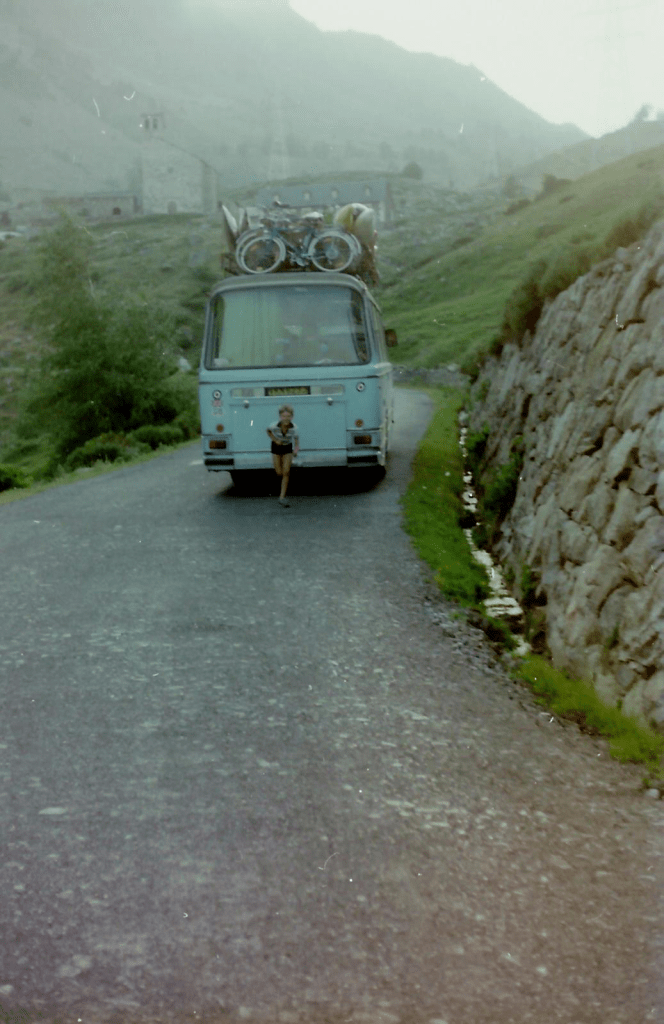
Beaky’s Bus mark 2 withe the RAF Canoe Team in the Pyrenees
I took many expeditions to Wales and Cornwall, climbing, sea canoeing and then mountaineering, white water and sea canoeing, eventually, travelling further afield, skiing and canoeing in the Alps. I took the RAF Canoe Team to the Pyrenees and the RAF Surf Ski Team to Cornwall routinely and once – to experience gigantic waves – to Portugul, (a round trip from Scotland of 5000 miles).
Posted to RAF Cosford in the Midlands, I took a cohort of RAF Apprentices on the bus to the Pyrenees where they searched high in the mountains for and finally located (they then build a memorial in remembrance on) the site where the crew of an RAF Halifax in 1944, had crashed in low cloud as they dropped ammunition to the resistance.
Beaky’s Bus – still banking with and audited by the non-Public accounts Officer – was now accruing funds in excess of what were required. Its income came from two sources; the Public purse as a mileage allowance per head – to which every expedition or sports member was entitled and from a small proportion of what each participant in the activity paid as their contribution towards the trip.
I now found that I could now really use two types of vehicle. Both would be very useful. One, was as a coach capable of carrying around 30-40 people on long trips to the Alps, primarily for skiing and another bus separately, as effectively a large 12-person camper van for expeditions where it could provide the members with transport and accommodation and a roof rack for large equipment such as canoes – In effect a mobile outdoor activity centre. Expeditions would both travel and live on a vehicle capable of accommodating (sleeping feeding and showering) and travelling 12 people.
The ex-Maidstone bus was still totally reliable, so I converted it into an activity centre. to accommodate and cater for expeditions of up to twelve personnel and I began the search for a second coach to cater for the many skiers for whom I now routinely provided UK and European-wide organised expeditions.
As before, I approached the Chief Engineer of, this time Western Scottish, the western arm of the bus firm that I’d worked for years earlier when I lived in Edinburgh, before I joined the RAF. As before in Maidstone, he was delighted to supply me with a vehicle – (for the same ‘prevent-competitors-benefitting’ reason) – He offered me a choice from a list of a dozen vehicles that he had recently removed from frontline duties. All had very high mileages, (around a Million) however they had been deployed exclusively on the luxury overnight London to Glasgow route and maintained meticulously. Fitted from new with air suspension, widely separated and reclining seats, darkened windows and a toilet/ washroom, they were ideal for ski trips that I organised out to the Alps.
Beak’s Bus, Mark three

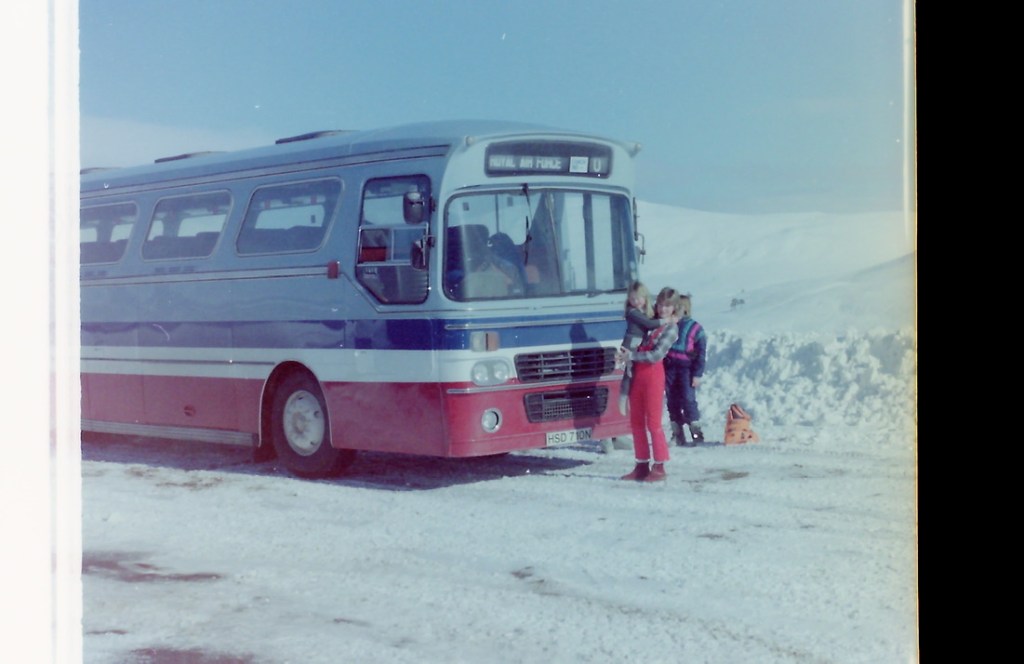

I bought one and, very generously, the Chief Engineer set his mechanics to work ensuring that, within reason no faults were apparent at the point of purchase.
Starting with the original little bus in which I had trundled the schoolboys to Rome, this was a much larger and hugely more comfortable vehicle. It still only cost three thousand pounds; the original bus that I had bought six or seven years previously from the Pleasance Trust Charity had cost six hundred. Now, the money in the fund could cope with this outlay. There were now two Beakys’ Buses.
What could go wrong?
More to come. In the next episode.
 Beaky's Blather
Leave a comment