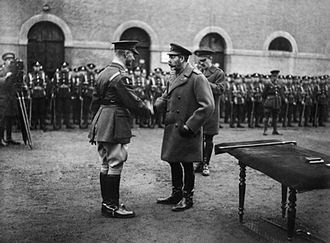
The Victoria Cross is given to few and awarded exclusively for: quote – “the most conspicuous bravery, or some daring or pre-eminent act of valour or self-sacrifice, or extreme devotion to duty in the presence of the enemy” – it is awarded only for the most extreme examples of heroism.
My father, born in 1916 grew up aware that a close family member, his father’s brother, Uncle Daniel, in 1918 had become Daniel Marcus Beak , VC, DSO, MC & Bar. Later, in WW2 he became General in charge of Malta during the famous siege in 1942.
Dad will quite possibly have sat on Uncle Daniel’s knee from aged two and listened to his stories. Perhaps it was this that set in his young mind just how individual and intense must endeavour be if you are to succeed. Whether or not his uncle’s knee had any influence on the wiring of his mind I can’t say however, repeatedly throughout his life he addressed the most extraordinary challenges in a most unconventional and individual fashion. Investigating the normal or expected way to address a problem and achieve success was never a priority or the start point for him when confronting any problem. Mostly it was not even a consideration.
In 1929, the Great Depression had devastated the economies of the Western World. Even people with qualifications, proven track records and brilliant work-related competences became unemployed and joined the long dole Queues as wholesale layoffs accompanied the collapse of businesses everywhere.
Today, the model for a sought-after employee may be – a precocious teenager with advanced IT expertise and a track record in computer hacking however, in the 1930s, being a seventeen-year-old graduate with an esoteric degree, and no work experience or discernible work-related competences, was not propitious. He couldn’t get a job.
Fortunately, Dora, Flora and Nora were at hand to provide morale and material support, so he lost neither self-belief nor starved. His father, my paternal grandfather, owned a boat yard, he built small boats and yachts on the River Hamble, and whilst he had been obliged to lay off most of his skilled men, he reluctantly took his son on as an apprentice wood worker.
For the first time in his life, my father had discipline imposed on him by someone, the head carpenter, who was unimpressed by his intellect. An expert tradesman and supervisor, he daily directed what, how and when dad was to do anything. This, my father told me years later – when I first complained about the imposition of a similar regime inflicted upon me when I was aged sixteen – was the making of him. It was also as far from the gentle clucking endearments of Dora, Flora and Nora as you may imagine.
He lived an almost bi-polar existence, occupying two worlds. By day at work, one within the ridged regime of an apprentice wood worker who received a kick in the backside for any failure, and at night in a complete contrast, that of a pampered princeling, served by a trio of maiden-aunt hand maidens, plus now Aunty Lye, his biological mother’s (completely normal) twin sister.
My grandad, his father, witnessed this contrast. As undisputed master of both his home and business, he was baffled. He retired each evening after dinner to his armchair before the fire, pipe smouldering, and read the daily newspaper, harumphing occasionally, either at what he read on the home front or witnessed in his own home, finding little comfort from either.
My father years later, explained to me that he recognised that he needed a solution. He wanted something different. The act of working wood he explained had provided him an interesting challenge however he had found producing anything to a predetermined, specified standard or quality, one that was commercially viable and for which a cost could be agreed with a client at the commencement of any task, was proving problematic. Some tasks he achieved to a standard of excellence uneconomically high whilst others, too low, producing a product that was practically unusable.
He had also filled out physically over his apprenticed years, and by the age of twenty-one at six-foot four and sixteen stone, was no longer eligible for a guiding kick in the trousers from his long-suffering supervisor. Something had to change.
Fortunately, America’s enthusiastic adoption of the economic principles advocated by Menyard Keynes had begun to re-light the fires of industry and by the mid 1930s, employment opportunities in the UK began to develop. My father’s career move when he made it, was characteristically non-linear and unexpected; He married my mother and joined the police. He was one of the first cohort on the graduates-only, direct-entry accelerated promotion scheme. This was an ill-judged scheme that quickly established itself as perhaps the most unpopular innovation in British Policing history there has ever been. Everyone, be they member of the public or existing police officer resented the new recruits with their accelerated promotion to superintendent opportunities, by-passing the years of hard-earned experience walking the beat demanded of all nongraduate PCs.
Hitler’s invasion of Poland ended that phase in his career and he found himself learning to march and fire a gun as he completed officer training graduating as Flight Lieutenant T W Beak, living in Fulton Block at RAF Cosford, only yards away from the line of huts that I was to work in as Flight Lieutenant P Beak, when Head of Training Design for seven years, fifty years later.
I will continue soon with Part Three of an Ordinary Man??


 Beaky's Blather
Leave a comment