One is fortunate indeed in life when good things continue and you happily enjoy your life, believing thoroughly in the value and rightness of what you do. It is understandable therefore that I might have anticipated that I would continue along this wonderful path through my life indefinitely, letting it roll forward in front of me. It’s rare indeed that this occurs for very long and I began to recognise on the horizon some warning signals suggesting that things might not remain so carefree for me and the happy band of outdoor instructors; the men who selflessly also gave up a great deal of their personal time to work with me and lead or support the many expeditions we provided to Service personnel drawn from across the RAF.
Those people, the SNCOs who worked with me supporting the many expeditions that I’ve described here were people that I had come over the years to know thoroughly – many are now friends even today, 40 years later. Back then in the 1980s, they gave their hard-won expertise generously, leading and ensuring success on so many expeditions – some on adventures that on occasion became extremely challenging.
There were some expeditions that became unexpectedly difficult in those days before radios and mobile smart phones could warn of weather, sea or snow conditions that – without warning – could turn against us. I admired and came to trust these expedition instructors utterly as time and again, they set off with their charges for distant places, often driving one or other of my buses. They are all people who gave back to the Service and their colleagues, effort and expertise, working overtime and a half, much of it drawn from what would otherwise have been their personal free time.
They, like me I think, really believed in the value of what we sought to provide. They contributed the extra time and effort beyond their day jobs and ensuring that we provided the expertise required of outdoor instructors even today on any adventurous training activity . We all ensured that our expeditions were focussed, purposeful, challenging, safe and enjoyable. To the benefit of what – over the years – was perhaps several thousand Service personnel..
My goal – that I feel we all supported – was rooted in the philosophy of Kurt Hahn. We provided stimulating, challenging and ‘character-forming’ experiences with the expressed goal of enhancing their personal leadership abilities, resilience and resourcefulness.
High falutin’ stuff you think? …Well, I’m not shy about making this claim. What we/they did was fuckin’ great, and I am proud of it and them. What we all did – those guys who worked with me – was make a really positive contribution to the lives of the people we took away.
It was a privilege to work with these ATIs. Should they read this some day, they will know who they are. Even today, decades later, I’m still grateful. Thank you, guys.
The bus project over the years inevitably began to draw attention. I found so often that I could hear some comment about it in the background voices. A quiet chorus of ‘Beaky’s bus….’ chimed somewhere across the room at almost any event that I attended even thirty years after leaving the RAF. On one occasion I recall, as I attended the funeral for a Warrant Officer with whom I had worked decades earlier, I heard still the old chorus, ‘Beaky’s bus…’ as my story was shared once more with those attending. I’m not sure even now whether what it was that I had whilst in the Service; was it fame or notoriety, who can say? I did however sense an increasing sceptical focus directed my way from those, largely employed in administrative roles in the Station Headquarters.
Curiously, I never received sceptical questions from anyone who attended any of our expeditions. Rather, the questions directed my way came from people that I seldom if ever saw seeking the adventures we offered. Increasingly, I found myself having to defend the approach that I had developed.
I was not really surprised. I thought it an inevitable consequence of working within the Service in what was clearly an unorthodox way. It is quite likely that at its peak, my volunteer instructors and I were handling – through our informal approach to adventurous training – nearly as many personnel on outdoor adventures as some established RAF outdoor centres provided with a substantial full-time staff.
My third posting was to RAF Cosford in the Midlands of England. Cosford was then and is still today I believe, a large training establishment. Culturally it was Support Command – therefore it had back then a more orthodox demeanour than had either of the two Fighter Command Stations on which formerly I’d worked.
What could go wrong. Oh dear… Where do I start…
Posted from RAF Leuchars in Fife, Scotland, with my family – (a standard NAATO – Wife and two children), I moved home and schools. moving one’s family is always a bit of a challenge however when bringing with you in addition two buses, it. throws up some extra. hurdles. My boss’ boss, as I arrived at RAF Cosford made it apparent early in my time there that he didn’t really see the value in my having a bus.at all. I didn’t mention to him that in fact I actually had two buses. Fortunately, RAF Cosford has a runway and also many very large hangers. I found a sympathetic ear in the officer who looked after the hanger that was dedicated to providing a safe indoor space for people’s caravans. I paid for two spaces and secreted both my buses in there out of sight.
Fortunately, my Boss’s Boss didn’t own a caravan, so he remained unaware of this arrangement and the buses were safely stored. I turned my attention to moving my family.
A great deal happened at this time and my life on this new unit became even busier however, as this blog post is about the Beaky’s Bus project not me, I’ll focus on that.
I received a letter from the MoD one morning in around 1985 explaining that a Mrs….. b…had enquired of the MoD as to my whereabouts, MoD asked me whether I wished to be contacted by her?’ It turned out she was the wife of R….. B…who had been a close friend of mine whilst we were both at Loughborough University. I mention this because it transpired when we met up as old friends separated by ten years after leaving college – that R….,owned a narrowboat hire business based on the canal basin in Worcester only 25 miles away.
That is relevant to project Beaky’s Bus because, when we met up and R… learned of my life in the RAF with Project Bus, he – now a man with a business mind – recognised immediately that hiring out vehicles configured like mine offered significant synergies if managed beside his narrowboat business. Narrow boats, he explained, are only expedition buses on a canal. He had, he explained both relevant experience and suitable facilities for such an operation. He could store, prepare the buses and hire them out without needing much in the way of extra facilities, staff or resources other than the vehicles.
He suggested that, as a company, he could continue to meet my RAF needs with a replacement for my old buses . He could prepare and hire to me any vehicles that I or others would require. Whilst in the RAF, I need only rent what needed from him – as and when I required. He would own the buses and, as a business, rent them out to all users, of which he felt certain there would be many.
Together we excitedly discussed what a great idea this was although, as I was currently in the RAF for a further six years, there was clearly a limit to how much I could be involved or contribute. R…saw this as no obstacle; He felt that I could still contribute expert guidance in a number of ways.
At some point in these discussions, it became obvious to us both that my coach-based expedition vehicle with its 12 beds and living facilities – beaky’s bus – as a model was commercially viable only if were able to sleep many more than the current twelve people. That was all that my trusty old Maidstone and District, converted bus was capable of accommodating and sleeping. A double decker bus became the vehicle we would require.
My track record in finding, purchasing and preparing a suitable vehicle was brought to the fore. It would be my first task. R…’would set up the business, and he alone could provide the finances that would be required.
The nearest potential source of a double decker bus was Wolverhampton or Birmingham City Transport however, neither city firm had vehicles constructed to be under four metres in height which was a requirement in most of Europe. I had to look further afield. After many enquiries, I learned that in the City of Stoke there are many low bridges, and that there they operated suitably-reduced-in-height double decker buses. Reduced height vehicles were essential there. I focused my investigations thereafter on the local-to-Stoke and Stafford bus companies; ones that operated reasonably nearby. One company that I found was called Potteries Motor Traction. I discovered the Chief Engineer’s name and arranged to visit him.
I received the by now familiar explanation – that he, the chief Engineer at Potteries, was anxious to ensure that he would not find any bus that he sold to me ended up in the hands of a local competitor. The day that I first approach him – I happened to be wearing my RAF uniform – rather fortunately as it transpired, because the chief engineer seemed to relax quickly, his mind at rest, convinced that in selling to me, the RAF, he was unlikely to be creating an issue about the vehicle ending up back in Stoke with a competitor. I didn’t disabuse him as to who exactly was seeking to purchase the vehicle. When I explained our plan for the vehicle’s conversion, removing most of the seats etc, he forgot about competitors completely and became quite enthusiastically intrigued and animated as we discussed our plans.
Once again fortune smiled on my bus search. He had eight low-height double decker buses that would be taken out of service very soon., probably in a matter of days as replacements arrived. He took me down to the garage and we boarded one of the eight soon-to-be-available vehicles, it was in the workshop for some repair. I asked that I might check its internal dimensions to ascertain the number/dimension of beds and seats we could build in.
This was the plan we envisaged:
Picture 1

Their bus seemed perfect for our needs with one exception. Unlike the rest of their fleet, all of their especially low-height buses had fitted the ill-favoured, headless, Perkins rather that the legendarily reliable Gardner engines. My many nights spent pouring over bus engineering manuals was about to pay off.
We talked buses in detail, and I began to recognised in his face and in the way he spoke to me, a growing respect. He was beginning to understand clearly that I knew my bus engineering stuff.
He eventually asked me how I, an RAF Officer, came to know so much about the somewhat esoteric matter of commercial vehicle engines? I described to him a little of my background for ten years or more operating, maintaining, repairing and dealing with the roadside, mechanical failures inevitably experienced when keeping million-miles on-the-clock, end-of-life buses functioning on trips all over Europe. I noticed that he was also beginning to hint at a much lower possible purchase price for his redundant, Perkins engine’d decker buses.
I opened my side of our undeclared bidding hinting towards a much-reduced bid-expectation. Before we settled on a final price however, I asked him to consider what he could do for us in the line of meeting our conversion needs and I saw his enthusiasm rise further. He showed me photos of some previous bus conversions that they had undertaken to create mobile classrooms from buses. He was clearly proud of the outcomes they had achieved. I bracketed my counter bid with a request that he fit flywheel clutches and alter the transfer gears to raise the buses cruising speed and I made some other suggestions related to airflow that might reduce the risk of high temperatures building up in the engine bay on long, top gear motorway journeys. I could see that I had blown his mind.
He sat back, looked at me and declared …‘How the… pardon my French,’ he stuttered. ‘How do you …?
RAF training, I hinted, deciding not to mention that, in reality, rather than training as an engineer in the Service, as he obviously assumed, I was in fact a Physical Education graduate.
A ‘need to know’ principle applied, I decided. It was my best policy here. We settled on a very modest cost for the purchase of a suitable vehicle, possibly two, and we agreed that he would calculate and propose a price for both the vehicle purchase and conversion to my spec.
The upper deck would need to change to this.
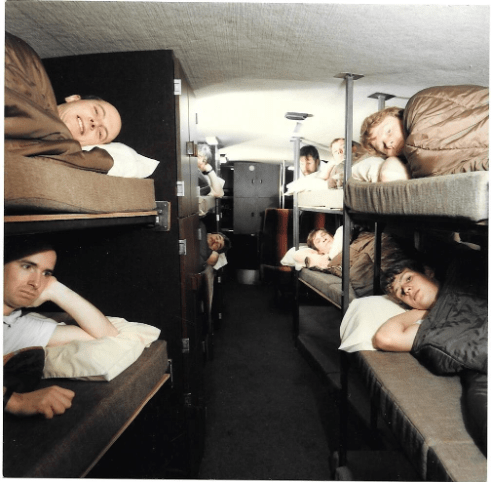
Downstairs would include the kitchen, toilet/shower and the lounge/dining area. The rear of the vehicle, provided tables and seats and TV monitors and provide a meeting/classroom area. Once converted, the vehicle would be effectively an 18-person camper van, serving as a mobile outdoor-adventure-training centre.
This low-height bus provided a group of up 18 people with transport, (for both people and equipment), It provided accommodation and washing eating and training facilities. In a large box trailer would provide storage and a drying room with a warm-air blower – the trailer served as both a storage and a drying room.
On board, it was possible – and we did so many times (whilst cruising at 65 mp down the motorway ) – cook a meal, eat and sleep in a bed as the vehicle moved to each new location, ready each morning to start the day’s activities having wasted by traveling over night, little time. We used the warm blown air heater in the box trainer as a drying room for wet clothing each evening even as we ate, slept and drove to our next destination.
Whilst living on board a bus was admittedly an organisation/ self reliance challenge, it was infinitely preferable to camping repeatedly at all times of the year as we had all done (both instructors and participants) for some years. For many activities, ‘Beaky’s bus,’ – (as even these replacement Viking Nomad vehicles were still universally described) – were ideal for the low budget training we delivered.
After my initial visit to PMT’s Stoke Engineering works, all that remained to be done was to, finance, purchase and convert the first bus, it later became two buses. All-in-all, it had been a rather satisfactory day, Rob and I concluded – as we discussed the first day when he called me to inquire how I’d got on locating a suitable vehicle. I explained that we had not only found our vehicle, but also identified a company that, (as they had operated the bus for years and knew it intimately) was ideally placed and willing/keen and able to supply the vehicles, complete the conversion and then provide on-going servicing. It would provide a contract to maintain the bus after the sale. Not bad I thought for a first day.
What could go wrong.
With a series of trailers, the vehicles could be configured for mountaineering, canoeing, skiing, cycling and surf ski and sports teams on tour. The first canoe trip that led, based on a Viking Nomad bus towing a canoe trailer was to the River D’Isere in the French Alps. We found Grade 5 water every day. This is hardly ever available in the UK. On other trips we configured the bus for skiing – in the Alps – with a box trailer for both equipment storage and with heating and a drying room. I recall taking one with the RAF Canoe team to the Pyrenees, and another, the RAF Surf team to competitions – in Northern Spain, configured with a specialist canoe trailer, I had once previously – with my old beaky’s bus- taken a group surf skiing to Portugal where we found gigantic, six-metre waves..
Beaky’s old expedition bus continued to serve until the Viking Nomad buses (as they were called officially) became available and displaced it as they were vastly more suited to most forms of expedition work. I found my trusty old 12-man expedition bus was no longer necessary and eventually I sold it to Stevensons of Uttoxeter a large coach company in Staffordshire who, to my surprise, replaced its body with a new one and it returned it to a third career as a commercial bus once more.
The other Beaky’s Bus, (incarnation 4), the much newer Volvo coach that I’d bought from Western Scottish, I retained for some years and used it mainly to take big groups on mountaineering adventures to Scotland and ski groups out to the Alps. Whilst I also hired the Viking Nomad vehicles regularly, as I know did many expedition leaders unconnected with me from other RAF units, I recall that I found them spectacularly good for the few cycling trips that I led and I recall that a number of RAF and civilian sports teams also used them for sports tours. I went on a couple of sport ventures – I used one for a hockey tour to Holland and northern Germany. and oneI know went to the Olympics in Barcelona.
I’ll give you an anecdote in conclusion.as I round this post off
Sitting in a bar one evening I recall R….. B….. describing to me a particularly embarrassing incident that occurred when he took a school hockey team in a Viking Nomad Bus on a tour of south Wales.
The President of the final hockey team that they played on their Welsh tour, showed a particular interest in the expedition bus, explaining that in addition to being President of the Hockey Club he was also Chairman of a large bus operation in South Wales, I don’t recall which one. Anyway, during the post dinner chat, Robbie apologised, explaining that a bolt in the bus’ engine had worked loose and as a result it had left a sizable oil stain in the hockey club’s car park.
‘‘Think nothing of it,’ responded the club President generously, and he invited R….. to bring the vehicle into his company’s brand-new, engineering facility in the morning; it was nearby, he would get a mechanic to steam clean the bus’s oil-covered engine bay.
In due course, the following day, R……. pulled into the very grand and polished engineering garage. He was directed to pull the bus over one of the inspection pits. and someone would steam clean it. The schoolboys trooped off the bus whilst the engine bay was cleaned , the Chairman of the bus company, accustomed to public speaking on almost any occasion – (the evening before he had presided over the dinner as President of the Hockey club, and after dinner speaker) – approached the gathered pupils and, calling for hush, began the type of speech such people generally feel obliged to deliver.
The boys politely listened and, as the Chairman reached the peroration of his speech, a boy who secretly had remained on board with an upset stomach and was, locked in the bus toilet, completed his business and in an attempt to flush, in error located and pulled the wrong lever. Immediately the bus began to discharge the foul contents of its capacious toilet-holding tank. The full 80 litres of accumulated effluent chugged, gurgled, splashed and plopped loudly as it disgorged its foulness in a cascade down into the spotless (until that morning) brand new, garage inspection pit adjacent to the startled mechanic wielding the steam cleaning lance..
There was a brief pause in the Chairman’s delivery as R……, turned back to face him wishing the ground might open and swallow him, while the boys, frozen to the spot, watched in horror until, with a… final, horrible gurgling gasp, the vehicle became silent once more. With barely a stutter in his delivery, the chairman completed his peroration and closed by inviting any of the boys, if ever in the area again to call in on the Club and with luck, they might join in a game….and perhaps whist in the area they should feel free to pop in and take a dump in his garage inspection pit again… anytime.
Beaky’s buses – eventually demobbed – their function now served under the banner of Viking Nomad, continued to carry people both from the RAF and from a wider civilian catchment to outdoor adventure and sporting activities and even the Olympic Games in Barcelona for a further ten years before retiring to a final chapter as a charity vehicle with the Jesus Army. Thus completing a circle. from charity bus to the same.
It was a wonderful period in my life. Career-damaging for me, probably – as radical innovation generally is likely to be -, I nonetheless had a wonderful military career. I spent it doing the very thing that I joined up to do. I suspect that it kept me from being posted to a more senior job behind a desk, at some bureaucratic centre, the fate of so many spirited people I met in the Service.. I avoided that fate for most of my RAF career thank goodness.
I have still today the fondest memories of some wonderful people who shared with me the experience and adventure of life on Beaky’s Bus.
Since I left the Service in 1995, I have never again driven a bus. My innovative spirit led me along other roads.


 Beaky's Blather
Leave a reply to simplysorro Cancel reply